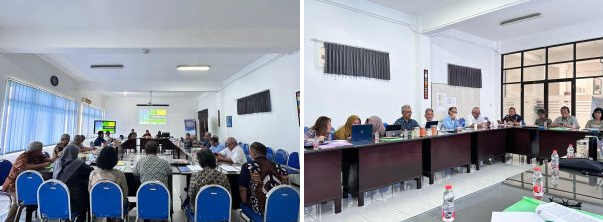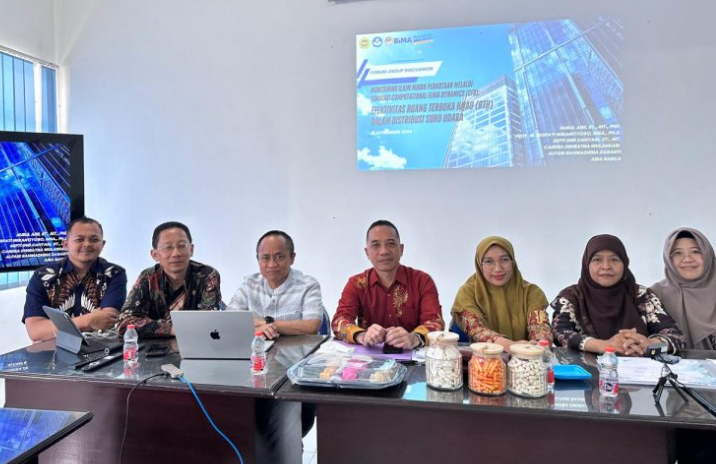
Malang, 21 November 2024 – Universitas Merdeka Malang once again held a Focus Group Discussion (FGD) with the theme “Monitoring Urban Microclimate Through Computational Fluid Dynamics (CFD) Simulation: Effectiveness of Green Open Space (RTH) in Air Temperature Distribution.” This event is part of the Fundamental Research Grant – Regular and National Competitive Research, led by the Chief Researcher, Nurul Aini, ST., MT., Ph.D., with team members Prof. Ir. Respati Wikantiyoso, MSA., Ph.D., Septi Dwi Cahyani, ST., MT., and students Candra Dwiratna Wulandari, Alfani Rahmadhina Dasanti, and Aira Nabila.
This event also invited the Secretary of the Malang City Environmental Service, Soni Bachtiar, S.E., M.M., as the main speaker to provide insights regarding the policy and role of RTH in mitigating urban microclimate change.
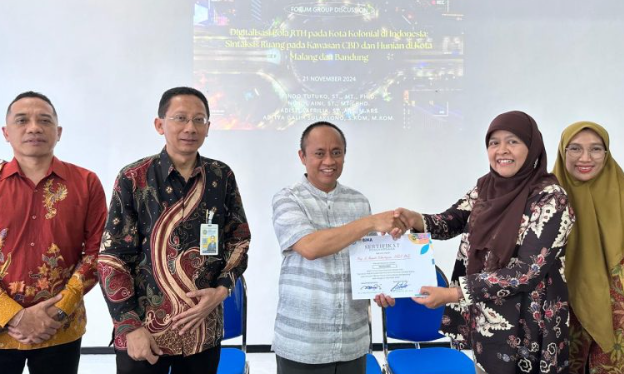
This FGD aims to discuss the research results using Computational Fluid Dynamics (CFD) simulations in mapping the effectiveness of green open spaces on air temperature distribution in urban areas. This topic is very relevant in global climate change, where green open spaces are essential in controlling air temperature and improving the quality of the urban environment.
In her remarks, Nurul Aini, ST., MT., Ph.D., explained the importance of a technology-based approach in understanding the dynamics of urban microclimates. “Through CFD simulations, we can visualize and analyze how green open spaces contribute to air temperature distribution in urban areas more accurately and in-depth,” said Nurul.
In his presentation, Soni Bachtiar, S.E., M.M., expressed his appreciation for the academic initiative to provide science-based solutions to support sustainable urban planning. “Green open spaces are not only an aesthetic element of the city but also play a strategic role in controlling air temperature and mitigating the impacts of climate change. We strongly support collaboration like this to produce data-based policies,” he said.
The discussion in this FGD covered various topics, including (1) The use of CFD simulations to understand airflow patterns and temperature distribution in urban areas, (2) a Comparison of the effectiveness of various types of green open space in reducing air temperature, and (3) Recommendations for green open space designs that are more adaptive to urban microclimates.
Prof. Ir. Respati Wikantiyoso, MSA., Ph.D., added that this study also considers sustainability and aesthetics in the design of RTH. “We hope that the results of this study will not only provide ecological benefits but also support the visual identity and comfort of the city as a whole,” he explained.