
Malang, 24 October 2026. Two new books by Prof. Ir. Respati Wikantiyoso, MSA., Ph.D. and his research team were published in October 2026. Both are research monographs, published by Selaras Media Kreasindo, Malang, in collaboration with the City & Settlement Laboratory (USH LAB), Architecture Study Program, Universitas Merdeka Malang.
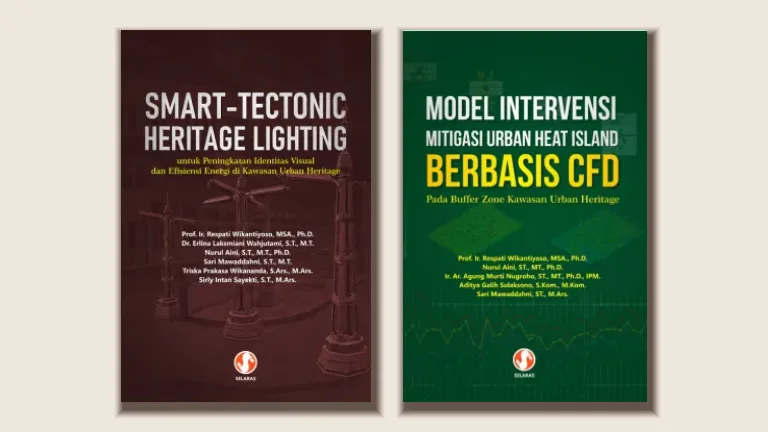
1. Smart-Tectonic Heritage Lighting for Visual Identity and Energy Efficiency in Urban Heritage Areas
Smart-Tectonic Heritage Lighting untuk Peningkatan Identitas Visual dan Efisiensi Energi di Kawasan Urban Heritage. This monograph is based on the 2025 internal research project “Exploring Street-Lighting Design as a Strategy to Revitalise the Visual Heritage Character of Malang”, funded by Universitas Merdeka Malang.
Its central idea is simple: street lamps in historic districts are not merely sources of light but urban artefacts that help tell the story of the city. By reading the visual character of Kayutangan, reinterpreting riveted-steel technology and testing designs with DIALux evo simulation, the book shows that visual identity, façade conservation and energy efficiency can be achieved together through the right design. The findings are summarised in the Context-Adaptive Smart-Tectonic Heritage Lighting (CASTHL) model.
- Authors: Prof. Ir. Respati Wikantiyoso, MSA., Ph.D.; Dr. Erlina Laksmiani Wahjutami, S.T., M.T.; Nurul Aini, S.T., M.T., Ph.D.; Sari Mawaddahni, S.T., M.T.; Triska Prakasa Wikananda, S.Ars., M.Ars.; Sirly Intan Sayekti, S.T., M.Ars.
- 1st printing, October 2026 · viii + 94 pages · 15.5 × 23 cm
- Print ISBN 978-634-7530-36-3 · Electronic ISBN (PDF) 978-634-7530-38-7
2. A CFD-Based Intervention Model for Urban Heat Island Mitigation in the Buffer Zone of Urban Heritage Areas
Model Intervensi Mitigasi Urban Heat Island Berbasis CFD pada Buffer Zone Kawasan Urban Heritage. Tropical cities face two mutually reinforcing heat pressures: global warming, which raises the regional baseline temperature, and the way cities themselves are built. Asphalt, concrete and metal roofs absorb solar radiation during the day and release it into the night, while the loss of trees removes natural cooling through evapotranspiration. Cities that are hotter than their surroundings show what is known as the urban heat island (UHI).
Heritage districts face a particular dilemma: protected heritage must keep its authenticity and integrity, so there is very little room for physical intervention in the core zone, yet rising temperatures threaten visitor comfort, the durability of old building materials and the economic life of the area. The monograph offers a way out through the idea of a thermal buffer zone: part of the mitigation burden is shifted to the buffer area in the Brantas River valley, where intervention is less constrained, with its thermal performance demonstrated through computational fluid dynamics (CFD) simulation.
The book complements two other research outputs, the Feasibility Study and the Academic Paper on CFD-based design criteria for heritage areas to control urban heat islands, and is written for academics, researchers, students and urban design practitioners who need a complete scientific basis: theory, method, data, analysis and discussion.
- Authors: Prof. Ir. Respati Wikantiyoso, MSA., Ph.D.; Nurul Aini, ST., MT., Ph.D.; Ir. Ar. Agung Murti Nugroho, ST., MT., Ph.D., IPM.; Aditya Galih Sulaksono, S.Kom., M.Kom.; Sari Mawaddahni, ST., M.Ars.
- 1st printing, October 2026 · viii + 142 pages · 15.5 × 23 cm
- Print ISBN 978-634-7530-37-0
This article also appears on wikantiyoso.labkota.com.