

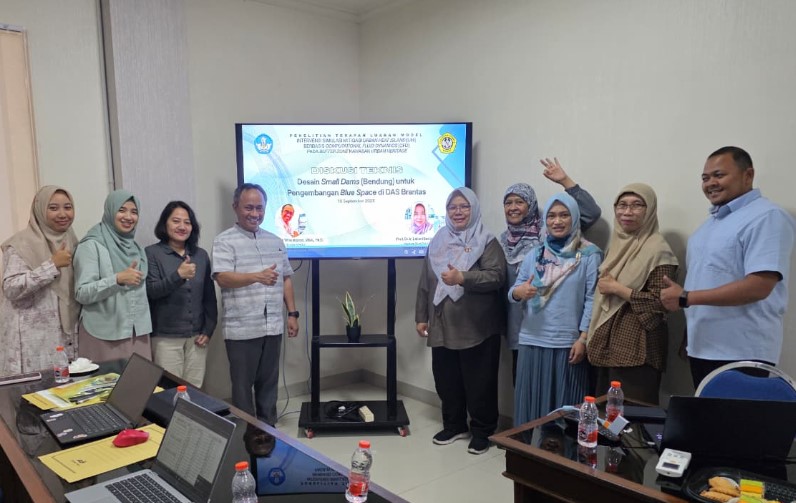
Malang, September 18, 2025. The Architecture Study Program of Merdeka University Malang held a technical discussion with the Civil Engineering Study Program on Thursday, September 18, 2025, in the Meeting Room of the Civil Engineering Study Program Building, from 9:00 AM to 11:00 AM WIB. Twelve participants, including the research team and lecturers from architecture and civil engineering, attended the event. This discussion was part of a series of collaborative research projects focused on the revitalization of drainage systems and riverbank management through ecological and social approaches.

Several key points in this discussion addressed technical, environmental, and social aspects of riverbank management in Malang City.
River Level Engineering and Hydrological Impact: Participants pointed out the importance of carefully considering efforts to raise river levels. While damming can increase water flow during the rainy season, in-depth studies of discharge and water levels are necessary, given that Indonesia’s annual cycle consists of six months of dry season and six months of rainy season. A water level rise of even 10 cm can significantly affect the planned design. Therefore, the technical study included (1) the impact of rising water levels on river or canal elevations; (2) water level elevations during the dry and rainy seasons; and (3) plans to construct reservoirs to collect rainwater before it re-enters the river or the main canal.
Furthermore, we discussed the need to review river boundary regulations and to use porous materials as an innovation for naturalizing riverbank areas.
Proposals for Utilization of Open Spaces and Reservoirs: In Malang City, open spaces, which account for 63% of the total area, have significant potential for optimization. The discussion pointed out the need for design interventions to preserve these spaces. Several key proposals emerged, including (1) using non-riverine areas as temporary retention ponds, (2) constructing reservoirs to store water before it enters the river system, and (3) integrating ecological, social, and recreational functions into public open spaces.
Study and Simulation of the Impact of River Change: Participants also stressed the importance of modeling the physical and biological effects of changes in the river. Water level data from Jasa Tirta are recommended for discharge calculations and analyses of ecosystem changes. A natural-materials approach is considered capable of helping restore the character of river areas to their original condition while simultaneously improving water absorption capacity and environmental quality.
Potential and Challenges for Riverside Village Development: Another topic of focus was the development of riverside villages. Lecturers and researchers assessed that the area has significant potential to improve the community’s economy, particularly through improved access and the use of the river view as an attraction. However, the government needs a clear policy on the direction of the village’s development—whether it should be positioned as a potential development area or as a vulnerable area requiring relocation.
The discussion also emphasized the importance of involving local communities in the planning process, given their in-depth ecological and social knowledge of their environment. One technical proposal that emerged was the construction of small dams and water retention ponds around the Splendid area, which could serve as a natural flood-control system. This activity provided an important platform for interdisciplinary collaboration between architecture and civil engineering at Universitas Merdeka Malang, particularly for formulating adaptive and sustainable design strategies for urban riverbank areas.